
The Courage to Question
Driven by a desire to challenge inequality, Shabnaz Wali reflects on her journey from questioning societal expectations to pursuing law and advocating for women's rights. For her, education is about empowering women to discover their potential and claim the freedom to shape their own futures.
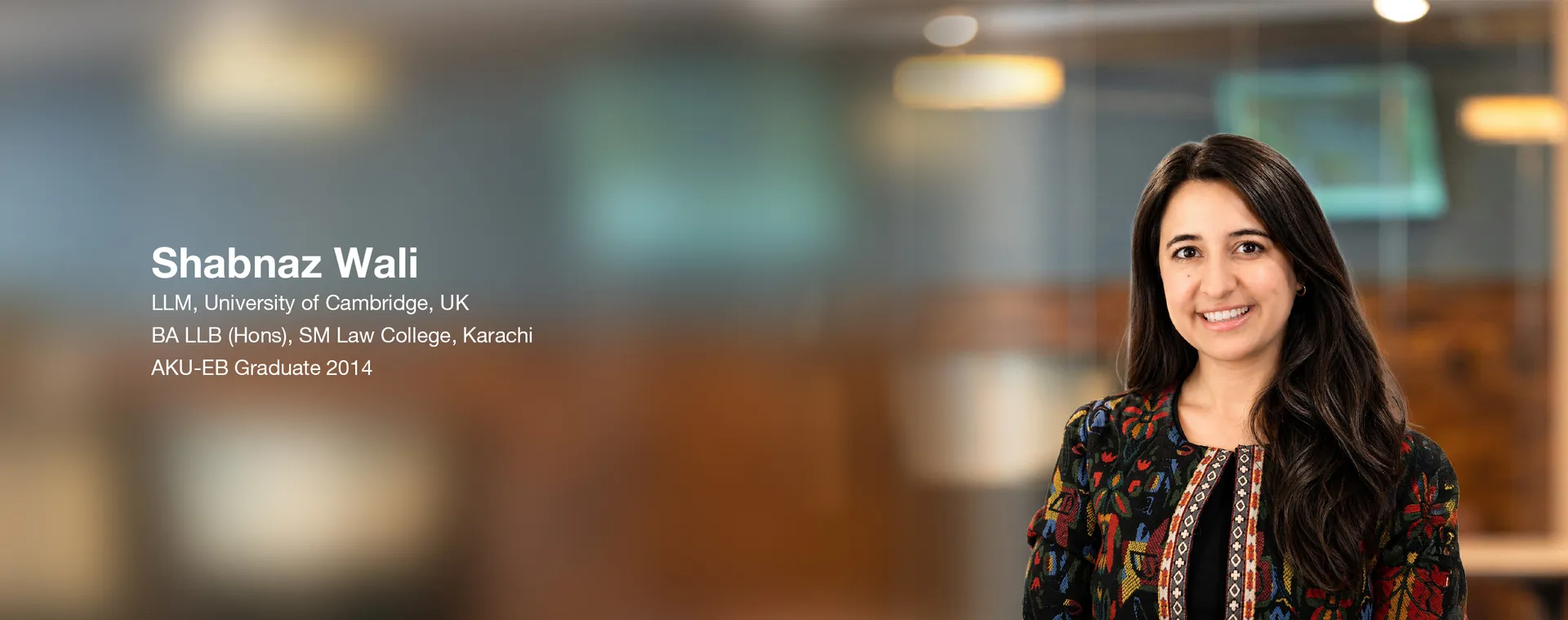
I come from Chitral, a place I carry with me wherever I go. My parents moved to Karachi because they wanted my siblings and me to have opportunities that were harder to access in our hometown. Growing up between these two worlds gave me an early awareness of how much a person's circumstances can shape the choices available to them.
I saw it particularly in the lives of women.
In northern communities, women carry enormous responsibilities, often with fewer opportunities to make decisions about their own lives. Education, mobility, employment, inheritance and even the freedom to speak for oneself can become difficult negotiations. I saw women around me navigate these realities, and I began asking questions that I could not easily put away.
Why should being a woman make life harder?
Why should a person's gender determine what she is allowed to inherit, study, become or say?
Those questions eventually became the foundation of my life's work.
The moment that changed my understanding of what I could do came in 2016, when I was selected for Youth Parliament Pakistan and elected as the Opposition Leader. Until then, I had thought about inequality largely through the experiences of people around me. At Youth Parliament, I began to see the machinery behind it—the way laws are made, policies are shaped and institutions can either protect people's rights or leave them vulnerable.
I realised that if I wanted to challenge injustice, I needed to understand the systems that produced it.
That realisation also made me look differently at my own life.
I was a pre-medical student because becoming a doctor was my parents' dream for me. I tried to follow that path, but I struggled with physics, chemistry and biology. I found myself drawn instead to social sciences, to questions about people, society and justice.
Choosing law meant going against an expectation that had been placed on me with love.
It was not rebellion for the sake of rebellion. It was the difficult recognition that I could not spend my life becoming someone else simply because that was the future others had imagined for me. After many conversations, I convinced my parents to let me change fields. I became the first person in my family to study law. I worked hard and graduated with a gold medal.
That experience taught me something I now consider essential to the work I want to do: sometimes, before you can challenge the structures around you, you have to find the courage to challenge the expectations placed upon you.
In Pakistan, the need to advance girls’ education and women’s rights is particularly urgent. More than 25 million children aged 5–16 are out of school, including 13.4 million girls (UNICEF, 2025). In Khyber Pakhtunkhwa alone, around 2.9 million girls are out of school. These are not just numbers to me. They are millions of girls whose choices may become smaller before they have even had the chance to discover what they could become.
“When you educate a woman, you do more than educate an individual. You expand the possibilities of a family, a community and, ultimately, a nation.”
I believe deeply that when you educate a woman, you do more than educate an individual. You expand the possibilities of a family, a community and, ultimately, a nation.
But education must be accompanied by rights.
At the Legal Aid Society, I worked with religious minority communities and on issues including discriminatory content in textbooks. That work contributed to advocacy that reached the Supreme Court of Pakistan. I have also researched testimonial inequality against women in financial matters, hoping that the evidence can contribute to legal and policy reform.
These experiences have shown me that change rarely begins with a dramatic moment. It begins when someone asks a question that others have stopped asking.
Why is this policy fair?
Why is this tradition still acceptable?
Why should a woman have to fight for something that should already be hers?
I want to become the kind of lawyer who is willing to ask those questions, and then do the difficult work of finding answers.
I know I cannot change Pakistan alone. But I have seen what happens when one person refuses to accept that something cannot be changed. I was that person when I chose law over medicine. I want to carry the same courage into my work.
I am pursuing law at Cambridge because I want to understand how law can become an instrument of social change: how policies can be challenged, institutions strengthened and rights made meaningful for the people who need them most.
And when I think of the girl I once was - the girl who struggled with science and wondered whether she was good enough - I wish I could tell her something.
You were never not enough. You were simply becoming someone you had not yet learned to recognise.
Perhaps that is what I want most for the girls who come after me: not that they all become lawyers, doctors or leaders, but that they are given enough education, freedom and courage to discover who they are - and the right to become her.
Because being a woman should never be the reason a life becomes smaller.